
The tightening cycle has begun in the region
Several of Malaysia’s neighbors have already moved on interest rates this year. The Philippines raised rates primarily to contain inflation, while Indonesia’s hike was driven more by the need to defend currency stability. The direction for interest rates in the region is clear.
Although the Strait of Hormuz has partially reopened, the economic damage from its closure between March and June is unavoidable. The direct impact — higher energy prices — has already shown up in the data. Attention should now shift to the indirect effects. The Prime Minister’s economic advisor has spoken publicly about a “second wave,” which he expects to materialize through higher prices for goods derived from petrochemicals.
What data are suggesting
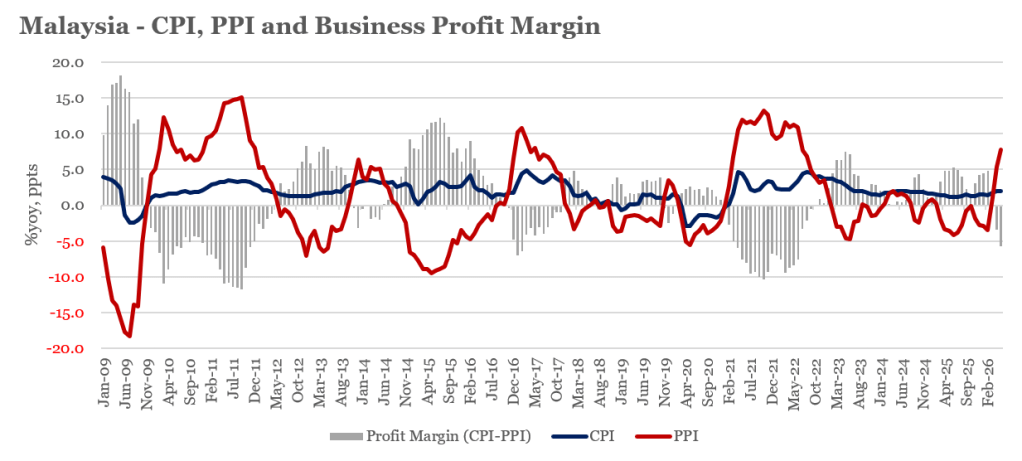
At face value, headline CPI appears manageable. But look beneath the surface, and the picture is more concerning. Producer Price Index (PPI) readings have risen sharply in the wake of the Strait of Hormuz closure. As a result, the margin between CPI and PPI — a proxy for business profitability — has turned negative, meaning that, in aggregate, producers are currently absorbing losses rather than passing costs on to consumers.
That cannot continue indefinitely. If the second-wave impact plays out as expected, PPI will continue trending higher in the coming months, and those cost pressures will eventually feed through to consumer prices. Based on historical patterns, this trend typically plays out over an average of 18 months.
Pay attention to services prices
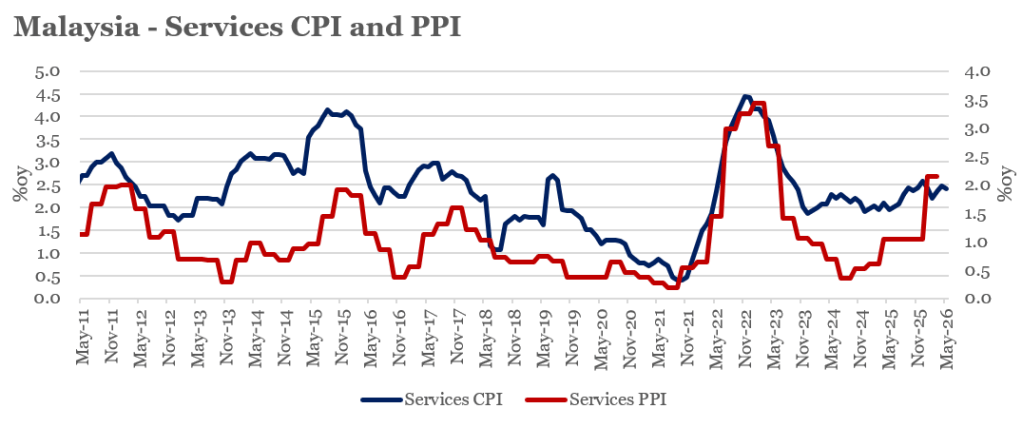
My immediate concern, however, is services inflation. The latest reading came in at 2.1% yoy — the highest since mid-2024 — and forward-looking indicators, including services PPI, point to further pressure ahead.
If the case for action is about anchoring inflation expectations, these indicators should give BNM sufficient grounds to adopt a hawkish stance at the upcoming MPC meeting.
The case for a hold
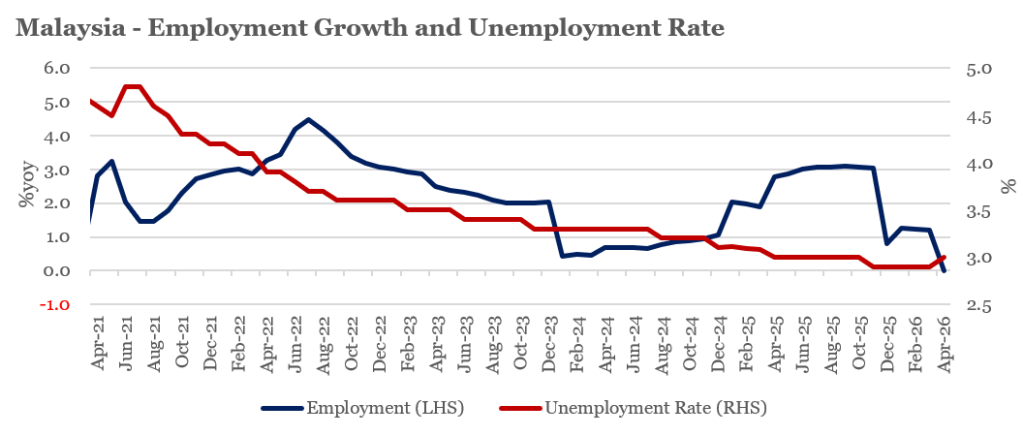
Nevertheless, there is a credible argument for keeping the OPR where it is — particularly given emerging signs of softness in the labor market. The unemployment rate edged up to 3.0% in April 2026 from 2.9% in March 2026, while employment growth dipped marginally to -0.01% yoy — the first negative reading since February 2021.
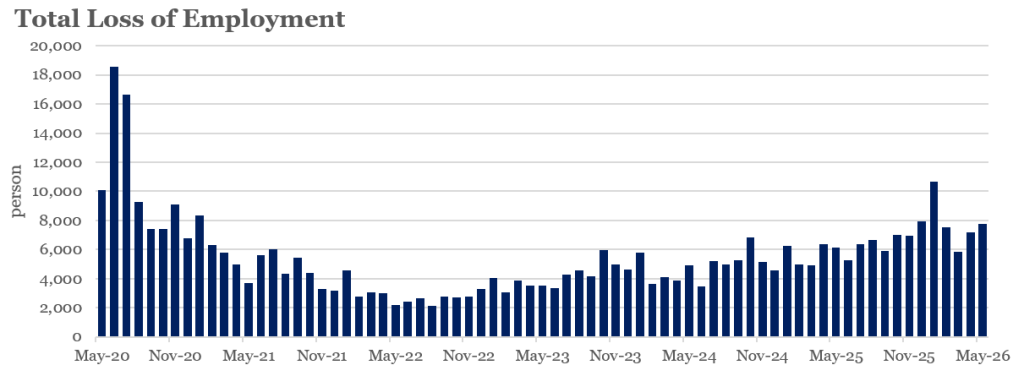
Digging deeper into SOCSO’s labor market data reinforces this concern. Total employment losses have been on a rising trend since 2022, becoming notably more pronounced in 2025, when monthly job losses averaged 6,237. In 2026, that figure has climbed further to an average of 7,791 losses per month — a trend that deserves serious attention.
Expecting intentionally neutral tone next week
There are a lot of moving parts here, and where the MPC lands will depend heavily on what the members collectively identify as the primary risk. Given that most MPC members are central bankers, my expectation is that managing inflation expectations will influence the policymakers psyche. I would not be surprised if the tone of next week’s statement is intentionally neutral — acknowledging the inflation risks without committing to a clear directional signal in either direction.